Brickinfo English
Thailand Faces Significant Financial and Infrastructure Gaps in Scaling Enterprise AI

Brickinfo News Agency – A new research report reveals a significant readiness gap between Thailand’s AI ambitions and the financial, operational, and infrastructure capabilities required to scale AI for enterprise deployment. The study, titled “Mind the Gap: Bridging the AI Infrastructure Readiness Divide,” highlights that while Thai organizations possess strong early adoption momentum, they face severe challenges in transitioning from experimentation to deep operational integration.
The research, commissioned by ST Telemedia Global Data Centres (STT GDC) and conducted by Ecosystm, surveyed 60 enterprise and digital native leaders in Thailand as part of a broader regional study. The findings place local organizations across four maturity stages: 14% are “Explorers,” 78% are “Builders,” 8% are “Integrators,” and 0% have reached “Leader” status. While the high percentage of builders indicates a market that has moved past proof-of-concept, the lack of leaders underscores the systemic difficulty in translating early AI deployment into sustained business value.
Financial pressures and uncertainty regarding return on investment (ROI) stand as the most immediate barriers to scaling AI workloads in Thailand. The study shows that 57% of Thai organizations cite budget constraints and ROI measurement difficulties as their primary challenges, ranking ahead of infrastructure limitations at 50%. This financial constraint is reflected in corporate spending behavior, with 76% of surveyed organizations allocating 5% or less of their total IT budgets to AI initiatives. Consequently, fewer than 10% of organizations report being operationally ready to scale their AI workloads.
“Thailand has made meaningful progress in moving AI from experimentation into execution, but many organisations are now encountering the more complex challenge of proving value and scaling sustainably,” said Budsarin Pradityont, Country Head, Thailand, ST Telemedia Global Data Centres. “Addressing this will require closer alignment between investment and outcomes, stronger access to specialised expertise, and infrastructure models that enable faster, more cost-predictable scaling.”
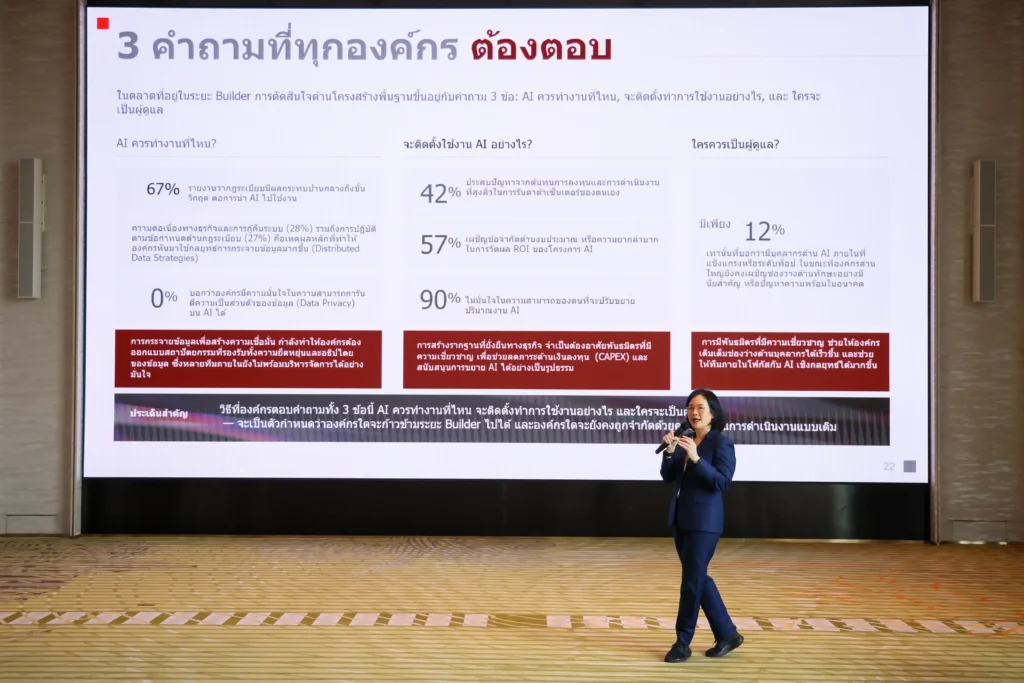
A persistent capability and talent shortage further slows execution across the industry. A significant 38% of respondents report a lack of in-house expertise required to manage complex infrastructure and operations. However, a visible disconnect exists in corporate decision-making, as only 8% of organizations prioritize specialized expertise when selecting their infrastructure partners, leaving internal teams constrained in their ability to design and operate advanced systems effectively.
Physical infrastructure bottlenecks also continue to restrict technological progress. More than half of the surveyed leaders note limitations in compute, storage, or network capacity as critical barriers. Only a small minority report having the performance, latency, and bandwidth required for advanced workloads, creating an execution gap where organizations can deploy solutions but fail to scale them reliably and cost-effectively.
Long-term operational, sustainability, and data risks are also emerging due to short-term infrastructure choices. While 50% of Thai organizations are investing in high-density AI hardware like GPUs, only 15% are actively deploying or exploring necessary liquid cooling solutions. Furthermore, 78% state that environmental, social, and governance (ESG) considerations remain secondary to performance and cost. Operational confidence is also impacted by data governance concerns, with zero surveyed organizations reporting absolute confidence in their ability to ensure data privacy in AI systems.
- Full Asia report, please visit: https://www.sttelemediagdc.com/resources/ai-readiness-assessment-report