Brickinfo English
NARIT Researcher Co-Leads Global Study Revealing Major Polarization Shift in Black Hole Jet


Brickinfo News Agency – An international research team, including a researcher from the National Astronomical Research Institute of Thailand (NARIT), has confirmed a rare and significant rotation in the polarization angle of radiation emitted by a supermassive black hole jet. Published in The Astrophysical Journal, the findings offer critical insights into the magnetic field structures and plasma dynamics governing relativistic jets in deep space.
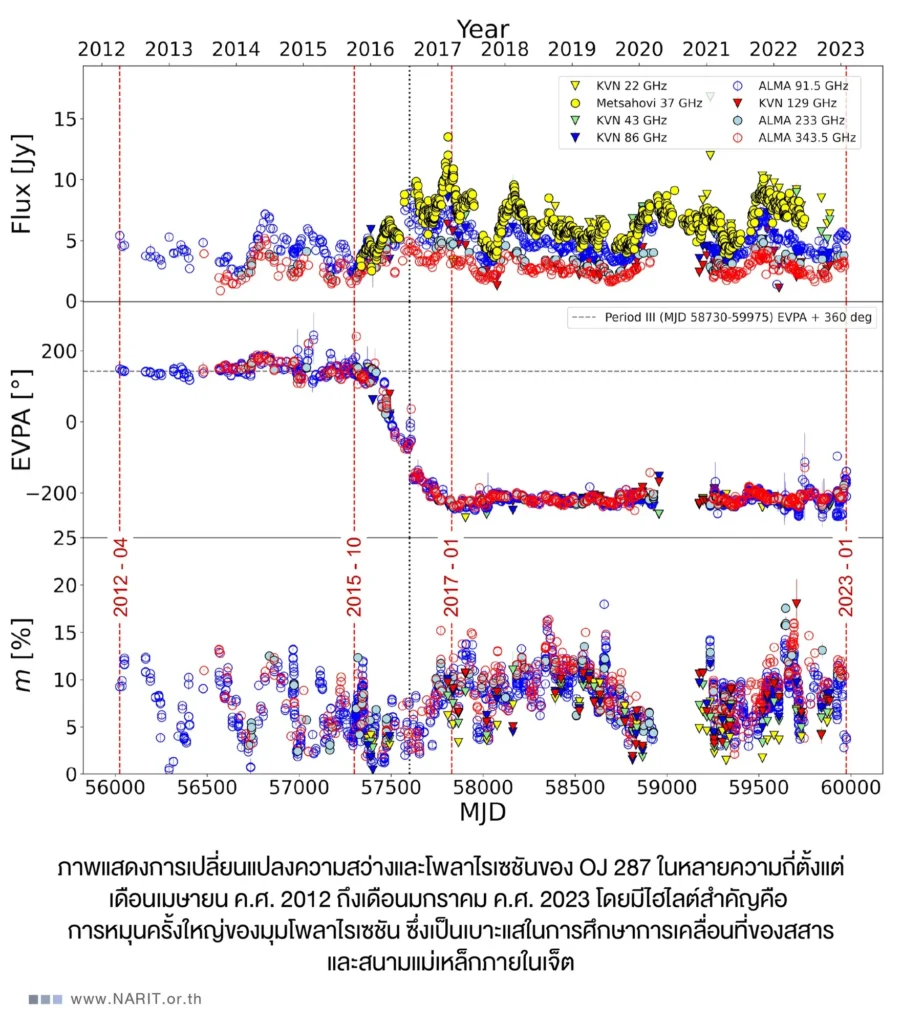
The study focused on OJ 287, a blazar situated approximately four billion light-years from Earth in the constellation Cancer. Blazars are active galactic nuclei powered by central supermassive black holes with relativistic plasma jets oriented almost directly toward Earth. By analyzing multi-frequency data gathered between 2012 and 2023 from the Korean VLBI Network (KVN), the Atacama Large Millimeter/submillimeter Array (ALMA), and the Metsähovi Radio Observatory, researchers identified an exceptional event spanning late 2015 to early 2017.
During this 1.5-year period, the Electric Vector Position Angle (EVPA) of linear polarization showed a smooth, continuous rotation exceeding 300 degrees at millimeter wavelengths, alongside concurrent optical shifts and a sequence of strong radio flares. The rotation corresponds to the orientation of the emitted radiation rather than the physical rotation of the black hole or the jet itself.
According to Dr. Wanchaloem Khwammai, a radio astrophysics researcher at NARIT, ALMA light-curve measurements yielded variability Doppler factors of 8 to 11 without significant increases during the flare sequence. This stability rules out relativistic beaming as the primary driver of the intensification. Instead, the data support a model where an ejected plasma disturbance propagated through a helical magnetic field within the inner jet, causing sustained shifts in the observed polarization angle..

The findings demonstrate that such extensive polarization rotations depend on transient alignments between internal magnetic geometry, moving plasma structures, and observer line-of-sight. The research establishes a framework for analyzing long-term polarization shifts to map high-energy astrophysical environments.