Brickinfo English
Thai Industrial Confidence Edges Up in January Amid Tourism Surge and Tech Investments


Brickinfo News Agency – The Thai Industrial Confidence Index (TICI) rose slightly to 88.7 in January 2026, up from 88.2 in the previous month, driven by a post-holiday production ramp-up and a robust recovery in the tourism sector. While the manufacturing of processed food and packaging gained momentum to meet Lunar New Year demand, the industry remains wary of high labor costs, delayed government budget disbursements, and the ongoing impact of PM2.5 pollution on public health and the economy.
The Federation of Thai Industries (FTI) reported that the slight uptick reflects positive momentum from the Eastern Economic Corridor (EEC), where the approval of seven data center projects worth over 96 billion baht has stimulated the high-tech sector. Additionally, pre-election activities and the printing of campaign materials have increased monetary circulation, while a de-escalation of border tensions between Thailand and Cambodia has allowed local economic activities to resume in frontier regions.
However, internal financial hurdles continue to suppress a more significant recovery. As of late January, government capital expenditure reached only 21%, falling short of the 26% target, which threatens to delay essential economic injections. “The government should consider extending support programs under the BOI’s Competitiveness Enhancement Fund through the end of 2026 to help reduce costs and strengthen the competitiveness of businesses,” stated the FTI as part of their official recommendations to the administration.
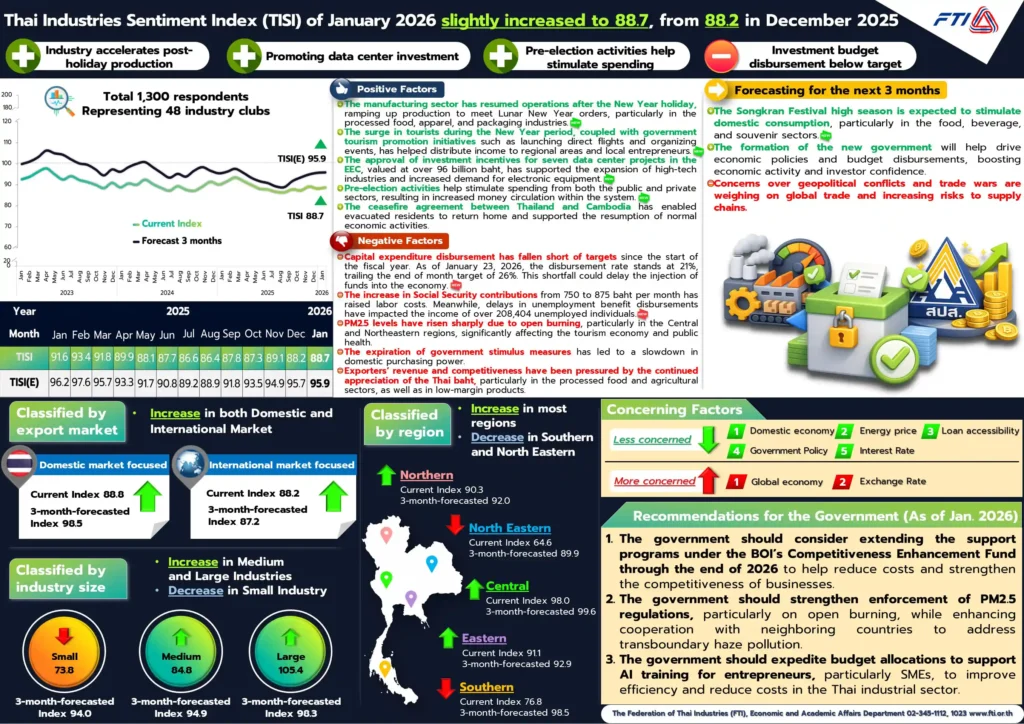
Rising operational costs are also a primary concern for Thai entrepreneurs. The increase in Social Security contributions from 750 to 875 baht per month has heightened labor expenses, while the appreciation of the Thai baht continues to squeeze margins for exporters in the agricultural and processed food sectors. Furthermore, the FTI highlighted that the expiration of previous consumption stimulus measures has led to a noticeable moderation in domestic purchasing power.
Environmental factors are now directly intersecting with industrial stability. The FTI urged the government to “strengthen enforcement of PM2.5 regulations, particularly on open burning, while enhancing cooperation with neighboring countries to address transboundary haze pollution.” The organization also suggested that budget allocations be prioritized for AI training to help SMEs improve efficiency and reduce long-term operational costs.
Looking ahead, the 3-month sentiment forecast stands at 95.9, buoyed by expectations for the upcoming Songkran Festival and the anticipated formation of a new government. Despite this optimism, the FTI warns that geopolitical conflicts and global trade wars remain significant risks to the supply chain. To assist businesses in navigating these shifts, the FTI has launched the Industry Data Space (iDS) dashboard to provide public access to real-time economic and industrial indicators.