Brickinfo English
Global AI Spending Projected to Reach $2.5 Trillion in 2026 Amid Infrastructure Boom


Brickinfo News Agency – Worldwide expenditure on Artificial Intelligence (AI) is forecast to hit $2.52 trillion in 2026, marking a significant 44% year-over-year increase. According to the latest data from Gartner, Inc., this surge is primarily fueled by massive investments in AI infrastructure, as technology providers continue to build out the foundational hardware necessary to support the evolving digital landscape.
The growth is heavily concentrated in the hardware sector, with AI-optimized servers expected to see a 49% increase in spending next year. This specific segment will account for roughly 17% of all AI spending, contributing an additional $401 billion to the global total as providers race to establish the technical foundations required for large-scale AI deployment.
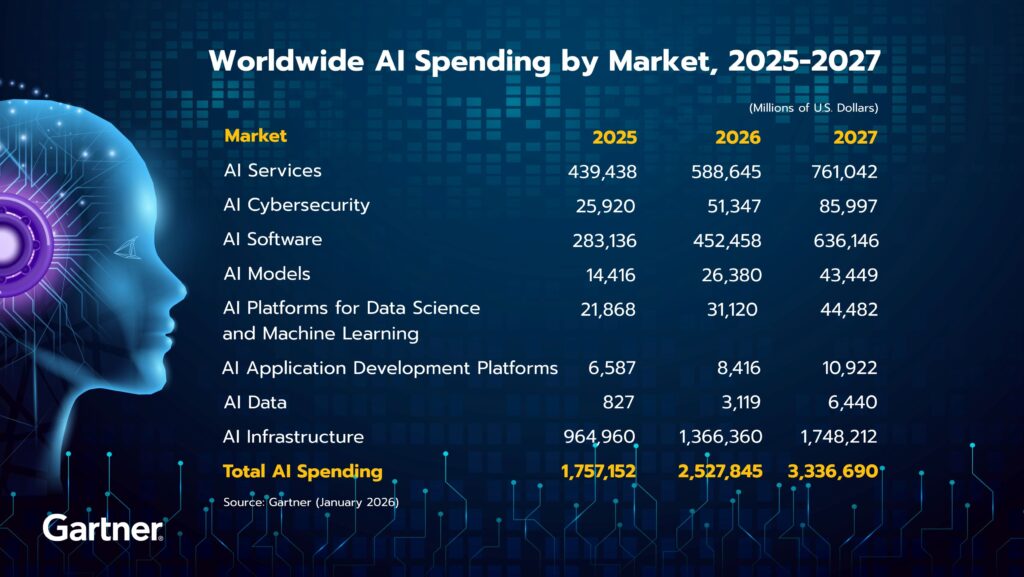
Despite the high spending figures, the report suggests a shift in how enterprises approach the technology. John-David Lovelock, Distinguished VP Analyst at Gartner, noted that organizational readiness is now the primary factor in adoption. “AI adoption is fundamentally shaped by the readiness of both human capital and organizational processes, not merely by financial investment,” Lovelock said. He added that mature organizations are beginning to prioritize proven outcomes over the “speculative potential” that characterized earlier investment waves.
The market is also entering a phase of reality-testing for many businesses. Lovelock observed that because AI is currently in the “Trough of Disillusionment,” enterprises are less likely to launch independent “moonshot” projects. Instead, AI is more frequently being integrated through existing software providers. This change reflects a demand for better return on investment (ROI) predictability. “The improved predictability of ROI must occur before AI can truly be scaled up by the enterprise,” Lovelock stated.