Brickinfo English
True Corporation Urges AI Integration for Thai SMEs to Drive Broad-Based Economic Growth

Brickinfo News Agency – Thailand must translate surging global artificial intelligence investments into practical capabilities for small and medium-sized enterprises to foster widespread economic gains and escape the middle-income trap, according to Sigve Brekke, Group CEO of True Corporation Public Company Limited.
Official data from the Thailand Board of Investment shows that investment promotion applications reached 1.47 trillion baht in the first half of 2026, marking a 37% increase year-on-year. Digital and AI infrastructure projects drove this expansion, totaling 1.12 trillion baht or approximately 76% of total applications. While this influx solidifies Thailand's strategic role as a regional data center and infrastructure hub, capturing lasting economic value requires converting physical installations into commercial productivity and operational capacity across the broader economy.
Small and medium-sized enterprises (SMEs) are critical to addressing Thailand's productivity imbalance. According to World Bank estimates, SMEs account for 99.5% of all enterprises and provide 69.5% of national employment, yet generate only 35.3% of gross domestic product (GDP). Approximately 85% of these firms operate as micro-enterprises with five or fewer workers and annual revenues below 1.8 million baht.
Industry research indicates a significant capability gap among local enterprises. A Salesforce survey noted that roughly 70% of Thai SMEs use or test AI tools, primarily for routine tasks. In addition, Amazon Web Services (AWS) found in its "Unlocking Thailand's AI Potential 2026" report that 74% of Thai AI adopters operate at a basic level, 17% reach intermediate integration, and only 9% achieve advanced implementation.
To bridge this divide, enterprise growth can advance across three operational tiers: AI-assisted, AI-operated, and AI-native models. Under the assisted stage, AI handles task-level activities such as content creation and customer messaging while human operators retain all decisions. In an AI-operated setup, integrated platforms automate core workflows—including demand forecasting, dynamic pricing, and inventory management. The final AI-native tier allows enterprises to package and commercialize proprietary AI systems as standalone revenue engines.
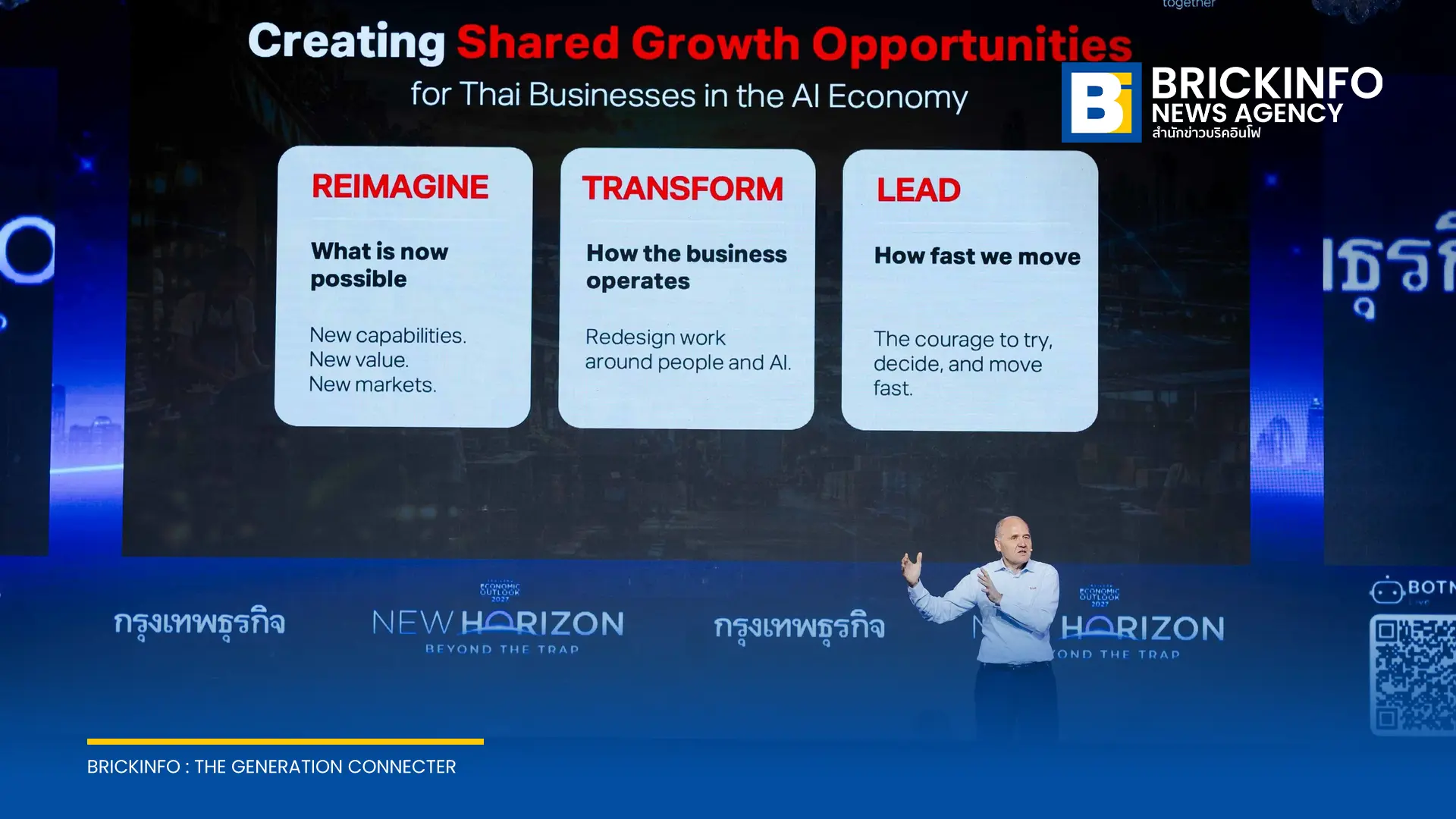
Facilitating this transition requires a structured approach centered on reimagining business models, transforming legacy operations, and executing rapid decision-making. Research from Boston Consulting Group shows that AI-guided discovery introduced consumers to previously unconsidered brands in approximately 63% of purchase journeys, reducing reliance on conventional advertising budgets in favor of clear, accessible data structures.
True Corporation outlined initiatives to support enterprise adoption, including True AI Hub, which aggregates over 50 AI models into a subscription-based platform starting at 399 baht per user monthly. The company is also collaborating with Charoen Pokphand Group (CP Group), Arise Ventures Group, AWS, and Amazon on training programs aimed at upskilling up to 3 million individuals, while advocating for balanced regulatory frameworks and testing sandboxes. Projections from Access Partnership estimate that comprehensive AI adoption could generate at least 2.6 trillion baht in economic value for Thai enterprises by 2030.