Brickinfo English
Gartner ThreatScape Identifies Deepfakes and AI Vulnerabilities as Critical Risks


Brickinfo News Agency – Gartner, Inc. has identified four critical, unpredictable cybersecurity threats where attackers currently hold a significant advantage: deepfakes, AI application compromise, prompt injection, and software supply chains. Revealed at the Gartner Security & Risk Management Summit, the Gartner ThreatScape framework classifies these risks based on available threat data and organizational management capabilities. Security leaders are being urged to adjust their defensive strategies, as emerging technologies create a high volume of noise that can obscure vital threat signals.
Regarding AI application compromise, threat actors are increasingly targeting production-ready enterprise tools, both internal and public-facing. The risk surface now includes custom-built agents, third-party integrations, and employee-only applications, which frequently expose sensitive data or credentials when controls are insufficient. Chief Information Security Officers (CISOs) are advised to apply a secure development lifecycle, utilize threat modeling, and leverage the Gartner trust and risk in security management (TRiSM) framework to embed protections directly into development processes. Enhancing data security through classification, purpose-based access control (PBAC), and runtime monitoring is also recommended.
“The introduction of security initiatives by frontier AI companies creates significant noise to an already noisy threat landscape,” said John Watts, VP Analyst at Gartner. “Cybersecurity leaders must be able to find the threat signal in all the noise in order to respond to shifts in the threat landscape.”
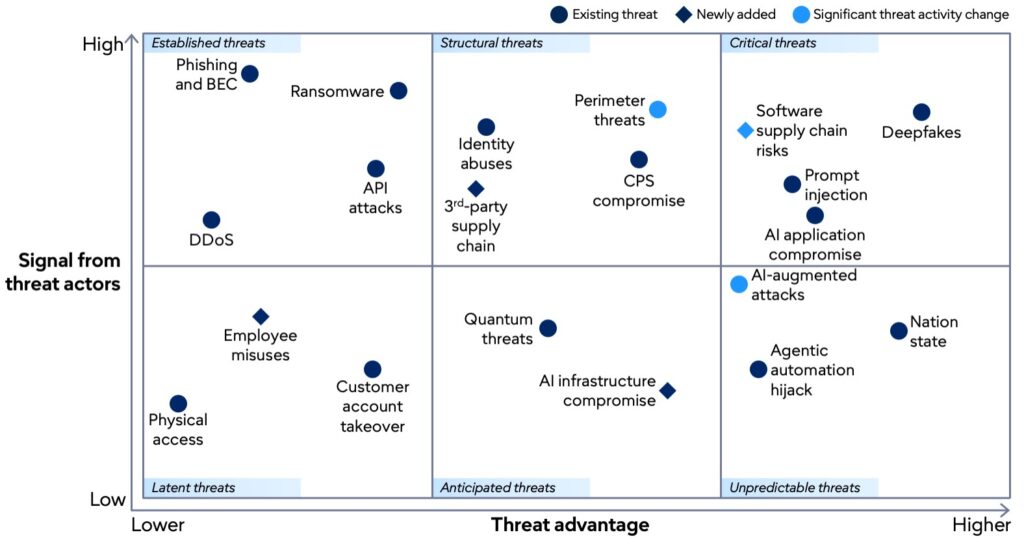
On the subject of identity impersonation via deepfakes, the accessibility of generative AI has led to a high volume of realistic synthetic voice, video, and image content. Attackers use these assets to subvert biometric authentication, execute social engineering scams against employees, and compromise recruitment systems. Experts note that single-control solutions are inadequate against these methods.
“Attacker use of deepfakes continues to advance and is now commonplace to make fraud and phishing scams difficult to detect,” Watts explained. “There is no one cybersecurity control that will protect you. Instead organizations should use a combination of strengthening business processes, improving awareness, and deploying available deepfake detection technologies where possible.”
To safeguard real-time communications and biometric verification, security teams must look past basic detection tools. Recommended actions include building multi-layered mitigation strategies tailored to specific use cases, targeting presentation and injection attacks during verification, and enforcing conditional access policies along with call metadata analysis during online meetings.
Software supply chain threats are also accelerating due to vulnerabilities within open-source components. Organizations are being advised to build comprehensive software inventories and integrate controls at every stage of development. To defend pipelines, CISOs should require a Software Bill of Materials (SBOM) and AI Bill of Materials (AIBOM) from vendors, utilize curated repositories for third-party code and AI models, enforce branch protection, sign artifacts during builds, and restrict build-system access to the principle of least privilege.
“The evolution of GenAI offerings will only accelerate the trend of software supply chain attacks through vulnerabilities in open source software,” Watts noted. “Organizations must work towards trusted component registries, hardening their CI/CD pipelines and building strong operational anomaly detection and response capabilities.”
Finally, prompt injection represents a severe danger to AI systems using large language models (LLMs). Attackers manipulate prompts to alter model behavior, causing unauthorized actions, control bypasses, or data leaks. Defensive recommendations focus on implementing input validation and sanitization, setting strong system prompts, establishing monitoring for abnormal AI behavior, and integrating prompt injection testing directly into the development lifecycle to optimize runtime guardrails.